Understanding Minimum Order Quantities for Footwear Manufacturing: The Small Brand’s Guide to Scaling with OEM Partners
Last updated:
- September 15, 2026
Key Insights
- Foot On Shoes’ MOQ is 300 pairs per colour and 600 pairs per style — two separate thresholds that do different jobs.
- MOQ is not a sales barrier. It is the point at which a leather cutting run, a last set and a size curve stop losing money.
- The per-colour minimum exists because dye lots and leather batches cannot be split economically. The per-style minimum exists because lasts, patterns and grading are fixed costs per design.
- A brand can hit 600 pairs per style with two colourways of 300, and that is usually the smartest first order.
What is MOQ in footwear manufacturing?
MOQ — minimum order quantity — is the smallest production run a factory will accept for a given style or colour. At Foot On Shoes it is 300 pairs per colour, 600 pairs per style.
Most published footwear MOQs are a single number, which is why they confuse buyers. Footwear has two independent cost drivers, so a single number always hides something. Splitting the threshold in two makes the economics visible and, in practice, gives the brand more room rather than less.
Why two thresholds instead of one?
The per-style minimum (600 pairs) pays for the design-side fixed costs.
Every new style requires a last, a graded pattern set, a cutting die set, and a sample development cycle. These costs are incurred once per design and do not shrink with order size. Spread across 600 pairs they are a modest per-pair figure. Spread across 100 pairs they dominate the unit price, and the shoe becomes unsellable at retail.
The per-colour minimum (300 pairs) pays for the material-side batch costs.
Leather is bought and dyed in lots. A tannery does not dye 40 square feet — it dyes a batch, and colour consistency is only guaranteed within that batch. Below roughly 300 pairs’ worth of material, you are either buying a full lot and scrapping most of it, or accepting visible shade variation between pairs in the same colourway. Neither is acceptable for a brand selling through retail.
Cutting, closing and lasting also run in colour-grouped batches. Every colour change on the line means a re-set: new thread, new edge finish, new sole colour, new cleaning cycle. Below 300 pairs the changeover time exceeds the production time.
The arithmetic, made concrete
| Scenario | Styles | Colourways | Pairs per colour | Total pairs | Meets MOQ? |
|---|---|---|---|---|---|
| A | 1 | 1 | 600 | 600 | ✅ Yes |
| B | 1 | 2 | 300 | 600 | ✅ Yes — usually the best first order |
| C | 1 | 3 | 200 | 600 | ❌ No — colourways below 300 |
| D | 2 | 1 each | 300 | 600 | ❌ No — each style below 600 |
| E | 2 | 2 each | 300 | 1,200 | ✅ Yes |
What MOQ is not
It is not a measure of how much the factory wants your business.
A low MOQ frequently signals a trading house that will place your order with a third-party workshop, because a middleman has no fixed costs to recover — only a margin to add. You lose visibility of who is actually making your shoes, which materials went in, and which labour standards applied. That is a poor trade for a lower first order.
It is not fixed forever.
MOQ is a floor for a first production run with a new brand. Once a style is in repeat production — lasts cut, patterns proven, materials on a standing order — the economics change, and so does the conversation.
It is not a retail concept.
MOQ exists because manufacturing has batch costs. Requests for one pair, or for a handful of bespoke pairs, are a different business entirely, and any manufacturer who says yes to a 600-pair brand order and a one-pair custom request with the same enthusiasm is telling you something about how they operate.
How MOQ interacts with lead time
MOQ and lead time are usually discussed separately. They should not be.
At FOS the sequence is: 2–3 weeks sampling, then 60–90 days production TAT from confirmed specification. Both figures assume the order meets MOQ. Below the minimum, small runs get scheduled around full runs, and the lead time stops being predictable — not out of preference, but because a 150-pair run cannot justify holding a line that could be producing 2,000 pairs that day.
This is the practical reason MOQ protects the brand as much as the factory. A supplier who accepts a below-minimum order has to deprioritise it to stay solvent. You will get the shoes. You will not get a reliable date. On a seasonal range, the date is the product.
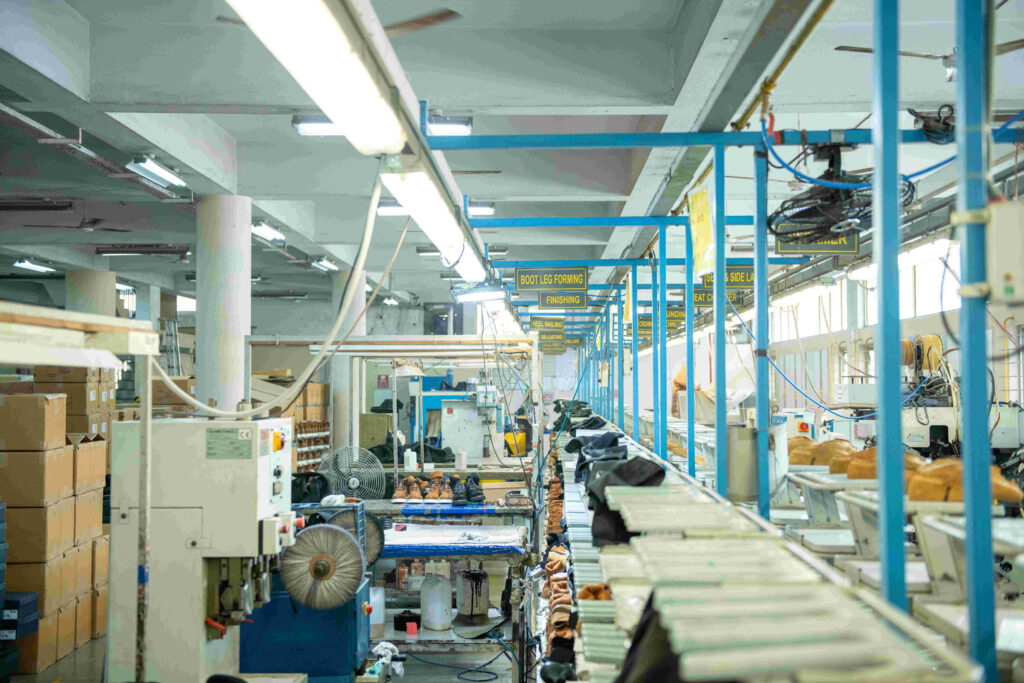
Production capacity at FOS runs at 1,800–2,000 pairs a day, so a 600-pair first order is not a large commitment in factory terms. It is roughly a third of a day’s output. The threshold is about batch integrity, not about turning away small brands.
Planning your first order
A practical approach for a brand placing a first order with an OEM or ODM manufacturer:
- Pick one style you are confident in, not three you are curious about.
Range development is where budgets disappear. Prove the relationship on one design. - Split it into two colourways.
One core neutral, one seasonal. 300 pairs each. This meets both thresholds and doubles your market read. - Build a realistic size curve.
300 pairs across a UK 3–8 curve is a genuine commercial run. Ask the factory for a curve recommendation for your market — the UK, German and US curves differ enough to matter. - Confirm the specification before you start the clock.
The 60–90 day TAT runs from confirmed specification. Every material change after confirmation restarts part of the sequence. The single biggest cause of late delivery is late decisions, not slow factories. - Ask what a repeat order looks like.
If the answer is the same MOQ and the same lead time forever, the supplier is not planning a relationship.
What to ask a manufacturer about MOQ
- “Is your MOQ per style, per colour, or both?”
A single-number answer means one of the two cost drivers is being absorbed somewhere you cannot see. - “What is the MOQ on a repeat order of an existing style?”
Tests whether the supplier distinguishes development from production. - “Do you produce everything in-house?”
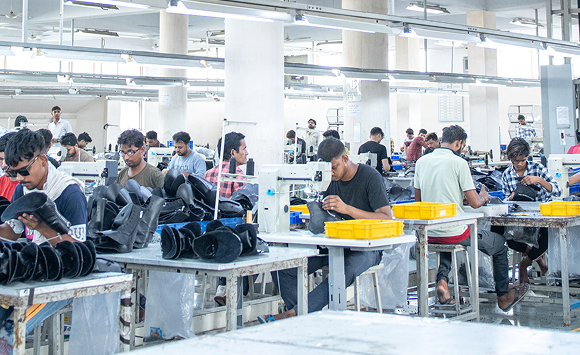
MOQ only means something if the factory quoting it is the factory making the shoes. FOS produces entirely in-house with no subcontracting, which is why the numbers are the same whoever you ask inside the company. - “What happens to the size curve if I go below the minimum on one size?”
Real answer: sizes at the ends of the curve get uneconomic first. A supplier who has thought about this will tell you where the curve breaks.
FAQs
- What is Foot On Shoes’ minimum order quantity?
300 pairs per colour and 600 pairs per style. A brand can meet both with a single style in two colourways of 300 pairs each. - Why is the MOQ split into per-colour and per-style?
They cover different fixed costs. The per-style minimum covers lasts, patterns, grading and cutting dies, which are incurred once per design. The per-colour minimum covers leather dye lots and line changeovers, which are incurred once per colourway. A single combined number would hide one of the two. - Can I order 200 pairs in three colours instead of 300 in two?
No. 600 pairs total meets the per-style threshold, but 200 pairs per colour falls below the per-colour minimum. Leather cannot be dyed consistently in lots that small, so pairs within the same colourway would show visible shade variation. - Does the MOQ change for repeat orders?
The economics change once a style is in repeat production — lasts are cut, patterns are proven and materials can sit on a standing order. Repeat-order terms are discussed case by case rather than published as a fixed number. - Is a lower MOQ from another supplier a better deal?
Not necessarily. A very low MOQ often indicates a trading house placing work with third-party workshops, which means you lose visibility of the actual production site, the materials used and the labour standards applied. Foot On Shoes produces entirely in-house with no subcontracting. - How long does production take once the MOQ is met?
Sampling takes 2–3 weeks. Bulk production runs to a 60–90 day TAT from confirmed specification. Foot On Shoes tracks on-time delivery internally at 98%.
Written by Sumit Joshan, Managing Director, Foot On Shoes. Foot On Shoes is an OEM and ODM women’s leather footwear manufacturer in Agra, India, founded in 1981.
More on capacity, lead times and production process on our footwear manufacturing page. To discuss an order, contact solutions@fos.co.in or +91-9719-001-004.
Ready to Create With Us?
Let’s discuss how Foot on Shoes can bring speed, and scale to your next collection.
Join Our Exclusive Community
Subscribe to our newsletter for the latest collections and exclusive offers tailored for you.
By clicking Subscribe, you agree to our
Terms and Conditions.